
Review · TAHITI
Half Day Whale Watching in a Small Shared Group
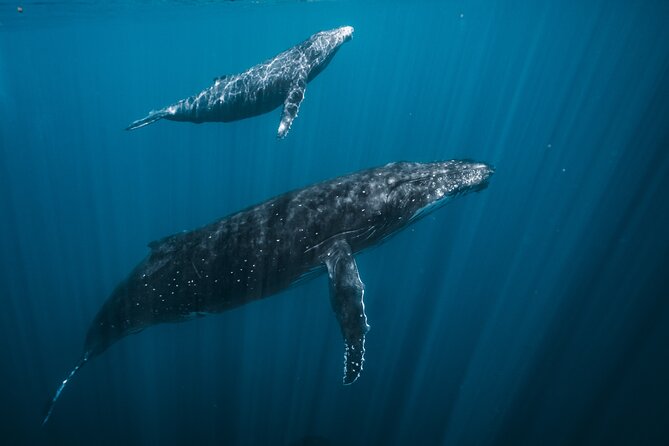
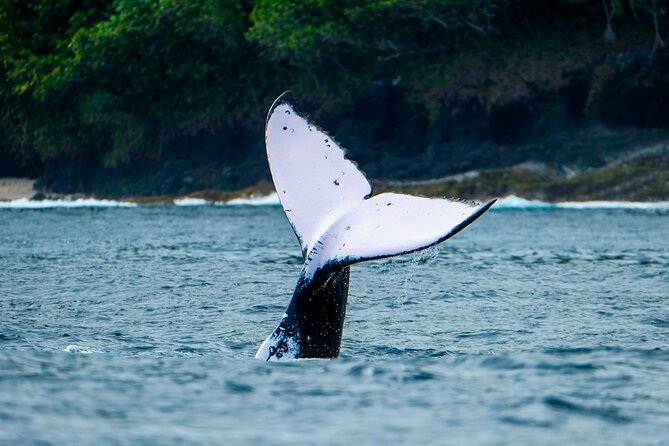
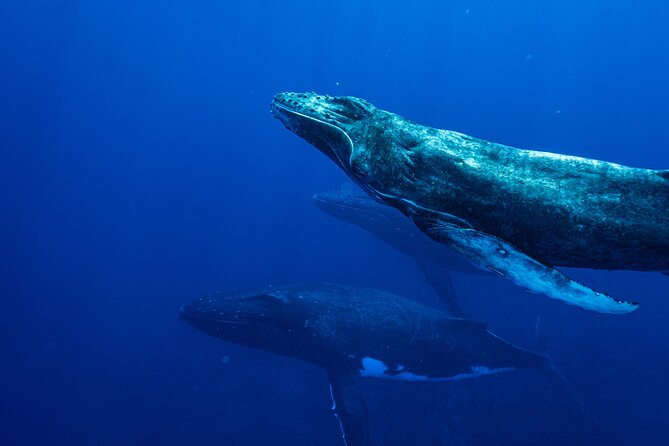
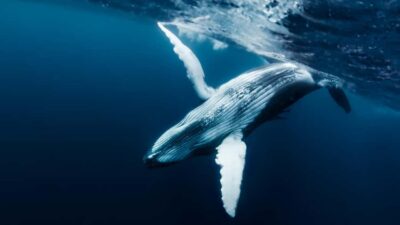
Tahiti’s humpback whales come here after a long migration from Antarctica to breed, give birth, and rest. This four-hour trip puts you on the traditional fishing boat POTI MARARA with no more than six passengers, giving the crew room to approach slowly and manage any time in the water with care. The chance to hear a whale sing underwater, or watch a curious calf move nearby, is the real draw.
I like the very small group, which means you are not waiting through several rounds of swimmers. I also like the crew’s clear respect for the animals, plus the practical extras: fruit, snacks, drinks, and snorkeling gear. The tradeoff is simple: this is a small open-water boat, so conditions can feel bumpy, and whale sightings or swims can never be guaranteed.
Key points to know before booking
- Six passengers maximum: You get a more personal outing and more room on the boat than on a large whale-watching vessel.
- Traditional POTI MARARA boat: The fishing-boat design adds a distinctly Tahitian feel, though the ride is still a small-boat ride on open water.
- Possible in-water whale encounters: If conditions and animal behavior allow, you may enter the water near humpback whales.
- Guides with a personal touch: JB, Solenne, Nathan, and Vehiatua are among the crew names associated with recent departures.
- Snacks and snorkeling gear included: Fresh fruit, snacks, water, juice, fins, masks, and snorkels are available.
- Weather matters: Poor conditions can cancel the trip, with a date change or full refund offered.
Why Tahiti is a special place for humpback whales
This is not simply a boat ride in search of large animals. Tahiti’s waters are part of the seasonal route humpback whales take after leaving Antarctica. They come into French Polynesian waters to breed, give birth, and rest, making the area important to the whales and especially meaningful for careful observation.
That timing also explains why the experience can feel calm one moment and full of anticipation the next. You may spend time scanning the water before a blow, fin, or broad back appears. The crew explains how humpbacks interact with their surroundings, why they migrate here, and what protection efforts are being made.
I appreciate that the emphasis is not only on getting close. The crew aims to keep the approach slow and respectful, with safety in mind both on the boat and in the water. That matters with an animal this large. A good encounter is not measured only by distance. Sometimes a whale passing quietly nearby, or its song carrying through the water, can be more memorable than a dramatic breach.
More Half-Day Whale Watching in French Polynesia
- Swimming with Whales in Moorea (Half Day tour)
★ 4.5 · 264 reviews - Half day whale tour 4h00
★ 4.5 · 181 reviews - Half Day Small Group Whale Watching
★ 5.0 · 88 reviews
Starting at Ārue Stadium and boarding POTI MARARA
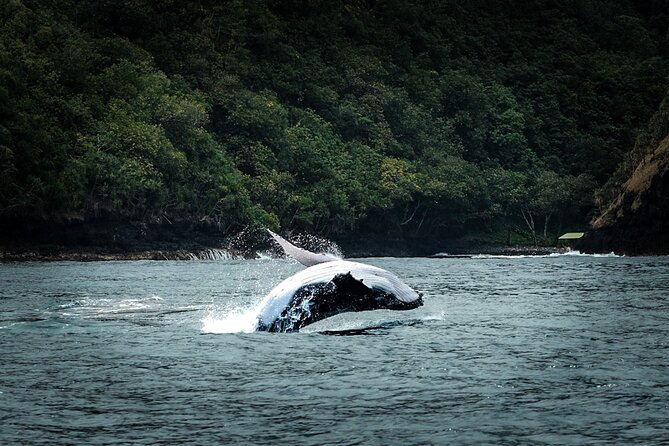
The meeting point is Ārue Stadium in Arue, on Tahiti’s north coast. The activity begins and ends there, so you should plan around that fixed meeting point rather than expecting hotel pickup or a one-way transfer.
The boat is called POTI MARARA, an iconic fishing boat with a typical Tahitian design. That gives the outing a more local character than a standard sightseeing craft. You are not boarding a large platform with rows of seats and a crowd. You are joining a small crew on a working-style boat built for the sea.
The six-person limit is one of the strongest practical reasons to choose this trip. On a larger boat, you may have to move aside for other passengers, wait for your turn in the water, or watch the action from behind a line of people. Here, the group stays compact. The guides can speak with everyone, keep an eye on changing conditions, and make decisions without managing a large crowd.
There is a compromise. A small fishing boat gives you a closer connection to the sea, but it does not offer the same space or stability as a large vessel. The ride may feel lively in open water. If you are prone to motion sickness, prepare carefully and remember that the tour requires a moderate level of physical fitness.
The search for whales during the four-hour outing
The main portion of the trip is spent looking for humpback whales. The exact order of events depends on where the animals are and how they behave. That is part of the nature of whale watching: the crew can search and follow responsible procedures, but nobody can schedule a whale to surface at a particular minute.
You may see one whale, several whales, a mother and calf, or no suitable opportunity to enter the water. The experience requires patience. The reward can be a brief appearance at the surface, a long underwater song, or a closer encounter that develops slowly.
The crew’s approach is deliberately careful. Once a whale is located, the boat moves in a way intended to reduce disturbance. The crew also decides if and when it is appropriate to get into the water. This is an important distinction from an activity built around forcing a close encounter. The animals set the pace.
The small group also helps here. With only six passengers, you can stay focused on what is happening instead of juggling a crowded boarding process. The guides can explain the whale’s behavior and give direct instructions before anyone enters the water.
Several crew members are named in connection with this experience, including JB, Solenne, Nathan, and Vehiatua. The names matter because the trip is built around personal guidance rather than a distant narration. JB is associated with both boat operation and whale encounters, while Solenne and Nathan are mentioned as welcoming, engaged members of the team. You should not assume a particular guide will be present on your date, but the named crew gives you a sense of the hands-on style.
What an in-water whale encounter can feel like

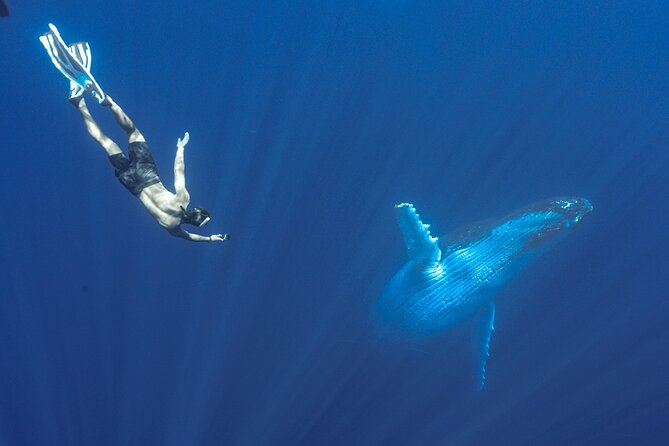
The possibility of swimming near a humpback is the feature that sets this outing apart from a standard boat-based whale watch. It is also the part that requires the most flexibility. You may enter the water several times, once, or not at all, depending on weather, whale behavior, and the crew’s judgment.
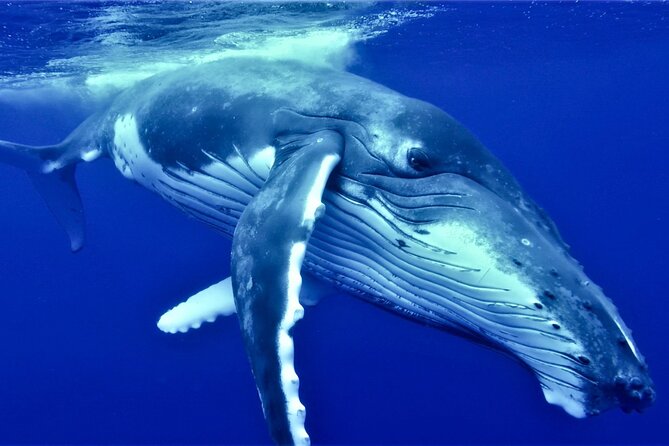
When an in-water encounter happens, you are likely to notice how quiet the setting becomes. Instead of the boat engine and conversation, you may hear the whale’s song through the water. One reported encounter involved the song vibrating through the swimmer’s body, an effect that is difficult to understand until you experience sound traveling underwater.
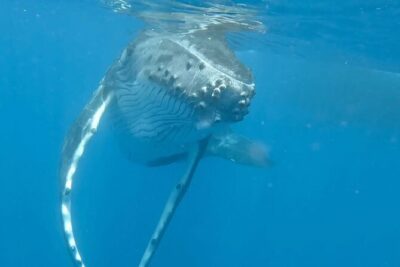
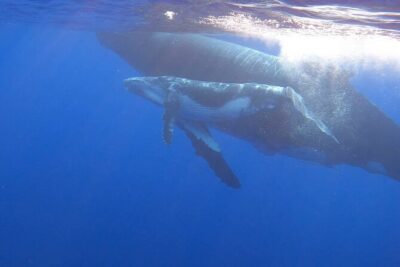
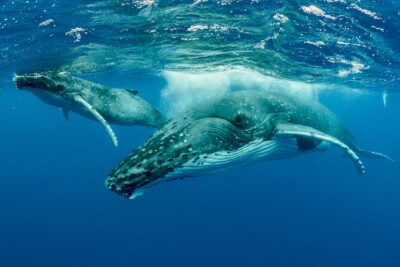
A calf may act curious and move around the group. A larger whale may pass at a slower, more majestic pace. These moments can be powerful, but they are not performances. The animal may disappear, change direction, or remain too far away for a safe swim. You need to accept those limits as part of responsible wildlife watching.
The crew’s role is especially important here. They manage when passengers leave the boat, how the group behaves, and when everyone returns. Since this is an open-water activity, you should be comfortable swimming and following instructions. The supplied information calls for moderate physical fitness, and that is a useful guide even though no exact swimming standard is provided.
Same water, a different way to meet the whales:
- Whale Tour – Observe and swim with whales
★ 5.0 · 257 reviews - Whale Watching Tours in Bora Bora
★ 4.5 · 250 reviews - Swim with humpback whales
★ 5.0 · 224 reviews - Humpback whale watching and marine life in Moorea
★ 5.0 · 199 reviews
Snorkeling, turtles, and the reef stop
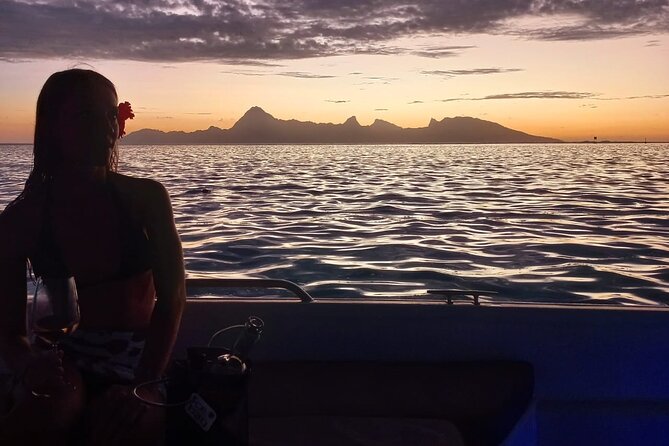
Snorkeling equipment is available if you need it, including fins, a mask, and a snorkel. The equipment gives the crew another way to round out the morning if whale conditions change or if the group reaches a suitable reef area.
Some outings include a reef stop, and a few encounters have included snorkeling with turtles. That is a pleasant addition, but it should not replace the main purpose of the trip in your planning. You are booking a whale-watching excursion first, with reef snorkeling as a possible extra.
The reef stop can also provide a welcome change of pace. After sitting alertly and watching for blows, you get a chance to look below the surface in a different setting. Still, the exact snorkeling location and duration are not specified, so you should not book this expecting a full reef tour with a fixed underwater itinerary.
If you use the provided gear, tell the crew what you need before getting into the water. The small group makes it easier to ask questions and get help with basic equipment. You should also expect the crew to put safety and animal welfare ahead of squeezing in another swim.
Food, drinks, and the practical comforts
Fresh fruit, snacks, water, and juice are served during the tour. These are modest extras, but they matter on a four-hour boat trip. You will have something to eat and drink without needing to bring a full meal, and fruit is a sensible choice in a warm, active setting.
Do not treat the snacks as lunch. The information only promises snacks, fruit, and drinks, not a substantial meal. If you need special food, the supplied details do not say that dietary requests are available, so you should ask before booking.
The trip’s mobile ticket makes arrival simple, and confirmation is provided at booking. Public transportation is nearby, though the available information does not give a route, schedule, or pickup service. You should make your own way to Ārue Stadium and allow enough time to find the meeting point.
The activity returns to the same place where it begins. That makes it easier to plan the rest of your day in Tahiti, but the four-hour duration is approximate. Keep your schedule flexible around the tour rather than booking a tight connection immediately afterward.
Is $236.85 a fair price?
At $236.85 per person, this is not a budget boat trip. The value comes from the format rather than from a long list of included attractions. You are paying for four hours, a maximum of six passengers, a traditional boat, an attentive crew, equipment, refreshments, and the possibility of a rare wildlife encounter.
The six-person limit is the key comparison point. If you would rather pay more for space, direct contact with the guides, and no large rotation of swimmers, the price can make sense. A larger, less expensive boat may be better if your main goal is simply to see a whale from a distance.
The price also reflects the uncertainty of nature. You are not buying a guaranteed swim with a humpback. You are paying for a well-managed chance to see these animals in their seasonal home, with a crew that can make responsible decisions when conditions change.
Because the tour is commonly booked well ahead of time, with an average booking lead of about 43 days, it is wise to reserve early if your Tahiti dates are fixed. That is particularly useful if you want a small group and cannot easily shift to another morning.
Weather, cancellations, and the best fit
The tour requires good weather. If poor conditions force a cancellation, you are offered another date or a full refund. The same applies if the minimum number of passengers is not reached. You can also cancel for a full refund up to 24 hours before the start time.
Inside the 24-hour window, cancellations and changes are not accepted, and the amount paid is not refunded. The cutoff uses local time. These rules are worth noting because ocean conditions can be changeable, but a last-minute personal change is treated differently from a weather cancellation.
This outing suits you best if you:
- Want a small, social boat rather than a crowded vessel
- Are comfortable with open-water conditions
- Have moderate physical fitness
- Care about respectful wildlife practices
- Like the possibility of swimming near whales
- Appreciate local guides and a traditional Tahitian boat
- Can accept that nature controls the schedule
It may not suit you if you need a guaranteed whale sighting, a calm and highly stable boat, a fixed snorkeling itinerary, or a full meal during the trip. You should also think carefully about the physical side of getting in and out of the water.
Should you book this Tahiti whale-watching trip?
I would book it if the small group is your priority. Six passengers is a meaningful difference, especially when the activity may include several opportunities to get into the water. The crew can keep the mood relaxed, explain what is happening, and manage the group without the usual crowding.
I would also choose it if you value a respectful approach more than a guaranteed spectacle. The strongest moments may be a singing whale below you, a baby whale moving through the water, or a large animal passing quietly nearby. None can be promised, but the setting and format give you a good chance to experience the sea without turning it into a noisy chase.
At $236.85, this is a special-occasion purchase. Book it when you are ready to accept the cost, the open-water ride, and the uncertainty of wildlife. If you do, reserve early, arrive at Ārue Stadium prepared for a four-hour outing, and let the whales decide how much of the story you get.
FAQ
Where does the whale-watching tour start?
The tour starts at Ārue Stadium, FFF8+XVV, in Arue, French Polynesia.
Where does the activity finish?
The tour ends back at the same meeting point where it begins.
How long does the experience last?
The activity lasts approximately four hours.
How many passengers can join?
The maximum group size is six passengers.
What boat is used?
The tour uses the POTI MARARA, a fishing boat with a traditional Tahitian design.
Are snacks and drinks included?
Yes. Snacks, fresh fruit, water, and juice are served during the tour.
Is snorkeling equipment available?
Yes. Fins, a mask, and a snorkel are available if needed.
Can I swim near the humpback whales?
The experience may include swimming near humpback whales, but this depends on weather, whale behavior, safety, and the crew’s decisions. It is not guaranteed.
What happens if bad weather cancels the trip?
You will be offered a different date or a full refund if poor weather causes the activity to be canceled.
Can I cancel for a full refund?
Yes, if you cancel at least 24 hours before the experience start time. Cancellations made less than 24 hours before the start time are not refunded.
Just added around French Polynesia
- Tahiti, land of whales: a unique experience!★ 5.0 · 11 reviews
- Observe and Swim with Whales in Tahiti★ 4.5 · 14 reviews
- Whale Watching Activity★ 5.0 · 8 reviews
- Whale watching DE Humpback West Coast of Tahiti★ 5.0 · 3 reviews
- Whale watching DE Tahiti Peninsula★ 5.0 · 12 reviews
- Whale watching in the calm of the peninsula with Tātahi tours★ 5.0 · 6 reviews
- 4 Hours of Humpback Whale Watching in Tahiti★ 5.0 · 36 reviews
- Whale watching and snorkelling in Moorea★ 5.0 · 64 reviews
Tahiti Whale Watching Tours, compared.
Guided Small Group Whale Watching and Swim Tour Tahiti
Read our review →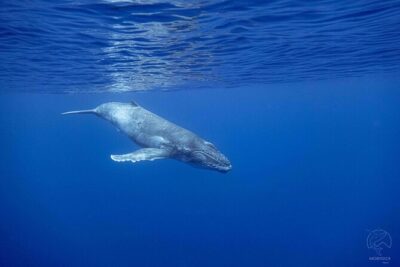
Whale watching on the preserved and quiet coast of Paea (Pk26)
Read our review →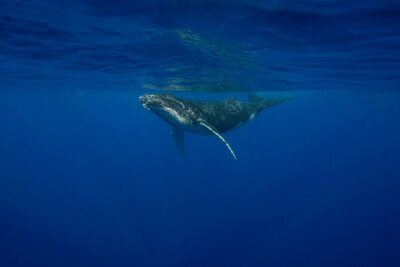
Browse the lists this tour appears in