
Review · NAHA
Okinawa Whale Watching From Naha
Whales can appear beside the boat, then vanish below the surface for several minutes. That uncertainty is part of the thrill, but this Naha cruise improves your odds with a trained crew, radar, sonar, and more than 35 years of whale-watching work. The winter season from January through March is the key reason to book.
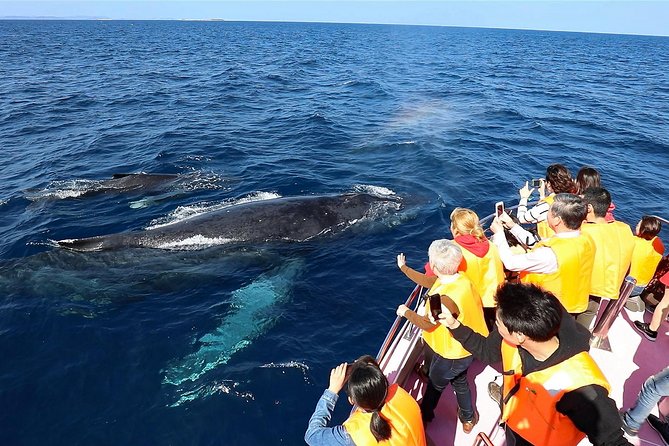
I like two things right away: the large double-deck boat gives you room to move when everyone spots a whale, and the crew provides hot and cold drinks plus raincoats if the weather turns damp. English guidance is another real help, especially when a guide such as Rita is on board and can explain what you are seeing in clear detail.
The main drawback is the sea. Even on a sunny day, wind can make the four-hour ride rough, and some people get seasick. You may also see whales at a respectful distance rather than right beside the hull, so bring realistic expectations and dress for an exposed boat.
Key points to know before booking
- Whales near the Kerama Islands: The cruise heads offshore from Naha to one of Okinawa’s best-known whale-watching areas.
- A four-hour winter outing: Trips run from January through the end of March, when humpback whales are present in Okinawan waters.
- Large two-level yacht: The boat has two toilets, a roof, and room to spread out, though seating can become limited when the boat is full.
- English help on board: A veteran English-speaking guide explains whale behavior, with marine biology guide Rita praised for especially clear explanations on some departures.
- Sighting protection: From February 1 through March 31, no whale sighting brings a full refund, subject to the operator’s rule that a whale, dolphin, or blow spotted by anyone counts as a sighting.
- Prepare for motion: Wind and waves can cause seasickness. Take motion-sickness medicine before departure if you know you are prone to it.
Why winter is the right time for Okinawa whale watching
This is not a year-round wildlife cruise. The operating season runs during winter, from January through the end of March, when humpback whales pass through Okinawan waters. The trip is built around a search for these seasonal visitors, not around a fixed coastal view or a guaranteed animal performance.
That matters because whale watching is never a clockwork activity. You may see a blow soon after reaching the search area, or you may need patience while the crew tracks movement across open water. The supplied information says the team has recorded whale appearances in 99 percent of outings each year, but that figure should not be read as a promise that every trip produces a close breach or a large pod.
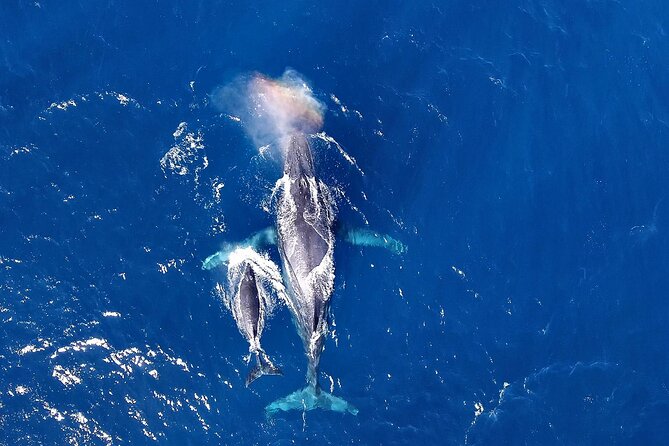
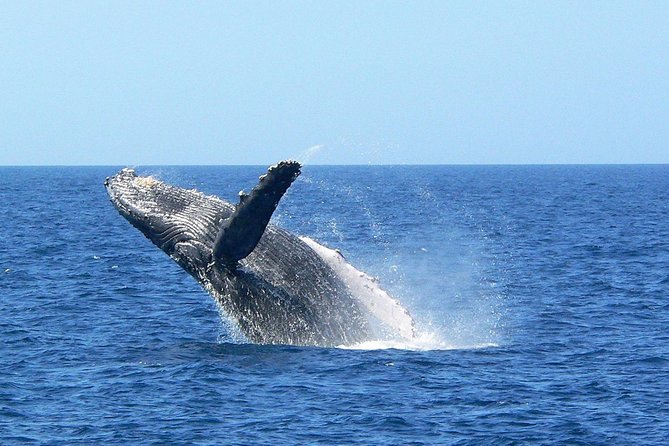
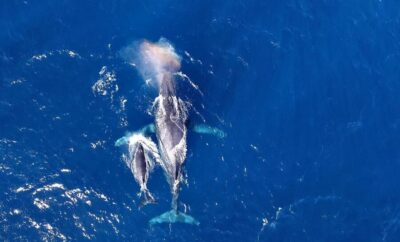
The reward is the possibility of seeing natural behavior. You might watch a mother and calf surface together, see a male whale join them, or catch a breach several times. One reported outing included five whales, while another saw three. Those moments are exciting because the animals choose what to do. The boat does not stage the action.
I also appreciate the operator’s stated record of more than 35 years in the whale-watching business and its recognition as a legally approved safe operator. That does not remove the normal risks of offshore travel, but it gives you useful context when choosing among Naha boat trips.
A few more whale trips around the world worth a look
- Tenerife: Eco-Yacht Whale and Dolphin Watching and Swimming
★ 4.7 · 15,619 reviews - Los Cristianos Respectful No-Chase Whale and Dolphin Safari
★ 4.6 · 12,782 reviews - Reykjavík: Whale Watching and Marine Life Cruise
★ 4.6 · 9,838 reviews
Leaving Naha for the Kerama Islands
The meeting point is Marine Club Berry at 2-chōme-3-13 Minatomachi in Naha. The activity returns to this same point after about four hours. A free shuttle is available from designated hotels, but you must request it in advance. Free parking is also offered if you plan to drive.
The single listed stop is the Kerama Islands. In practice, this means the outing is focused on getting offshore into the whale area rather than stopping at several islands for swimming, sightseeing, or lunch. You should think of it as a dedicated wildlife cruise.
The boat is a large, high-speed, double-deck yacht with two toilet rooms. That is a practical advantage on a four-hour trip, especially for families. The upper deck and roof give you different ways to watch, though open areas can feel windy. One departure had enough room that the boat did not feel crowded, while another noted that seating was a little short for the number of people aboard. The stated maximum is 35 participants, so this is not a tiny private boat.
The crew uses radar and sonar while a naturalist searches for signs of whales. Those tools help the staff organize the search, but they cannot control where an animal surfaces. You will still need to watch carefully and respond quickly when the crew points out a blow or movement.
What the whale encounter can really look like
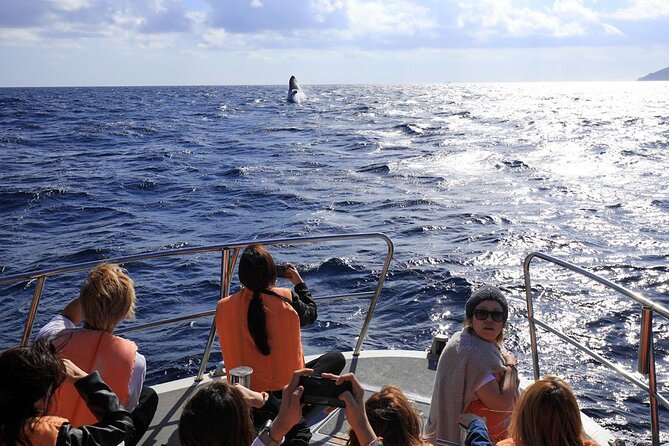
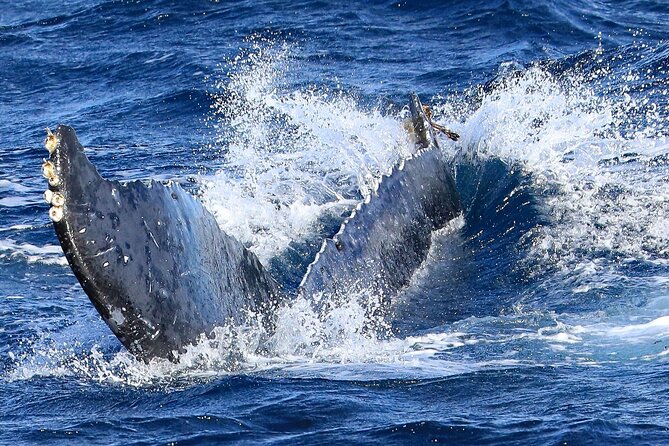
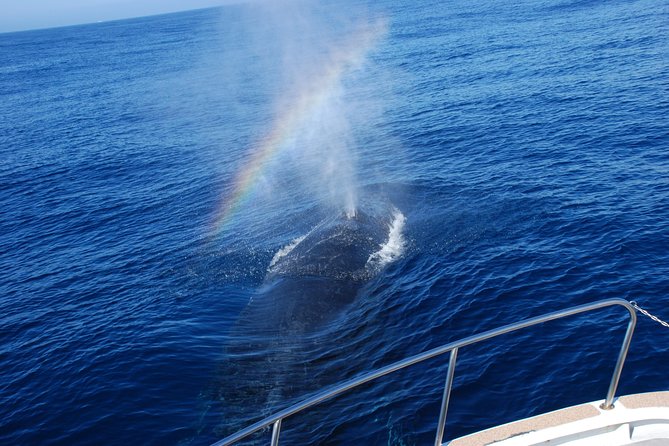
Humpback whales do not remain at the surface for your convenience. A whale may appear, breathe, and disappear again. One account described surfacing roughly every five to seven minutes, while another described several breaches. Both patterns are normal reminders that you are observing a wild animal from a moving boat.
The boat is not allowed to approach too closely unless the whales themselves swim toward it. I consider that a positive rule, even if it can feel disappointing when you hoped for a close-up view. A respectful distance protects the animals and gives you a more honest encounter.
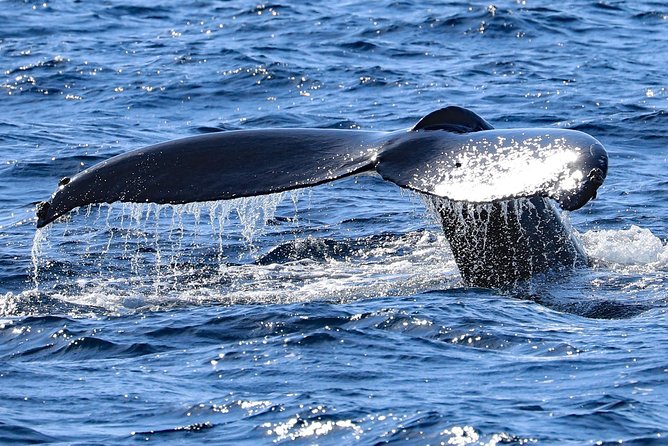
Keep your camera ready, but do not spend the whole trip looking through a screen. A blow can be easy to miss, and the most memorable moment may be a tail, a back rolling through the water, or a mother and calf surfacing together. Downloadable photos are included, which takes some pressure off getting perfect images yourself.
The crew also provides a downloadable whale-watching booklet. Read it before or during the ride if you want a better grasp of what you are seeing. The guide’s explanations add value here. Rita, specifically praised for her clear English and marine biology background, has been noted as an especially strong source of information when she is assigned to the boat. Staff members speaking English are available, though the exact guide can vary by departure.
Comfort, wind, and seasickness
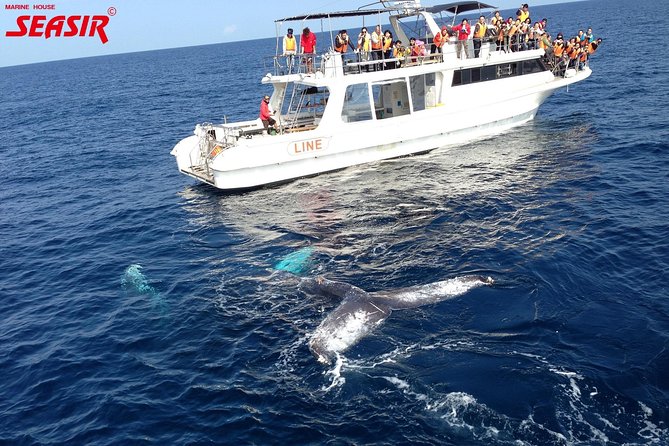
The practical equipment is simple but useful. Life jackets are included, raincoats are available if needed, and hot and cold drinks are provided. Meals are not included, so eat before boarding or bring your own plan for food after the cruise.
A sunny forecast does not mean a warm or calm boat ride. Wind on open water can be sharp, and the ride may feel much colder than Naha’s streets. I would wear warm layers, a windbreaker, and a hat that will not blow away. The crew’s own advice to bring a windbreaker and hat is worth following.
Seasickness is the biggest comfort issue. Several people have become ill on the boat, while others had no trouble. That difference is common on offshore excursions, but the speed and exposure of this trip can make motion more noticeable. If you already know you are sensitive, take seasickness medication before departure according to your doctor’s advice and choose a place where you can keep your eyes on the horizon.
The boat has a roof, but that does not mean every viewing position is sheltered from wind. Move around when safe, keep one hand free, and follow crew instructions. The two toilets are welcome, but they do not change the fact that you are spending several hours at sea.
Same water, a different way to meet the whales:
- From Funchal: Ecological Catamaran Dolphin Whale Watching
★ 4.5 · 8,204 reviews - Juneau Wildlife Whale Watching
★ 5.0 · 7,379 reviews - Juneau Wildlife Whale Watching & Mendenhall Glacier
★ 5.0 · 6,236 reviews - Funchal: Dolphin and Whale Watching Catamaran Cruise
★ 4.5 · 5,697 reviews
How much value do you get for $38.22?
At $38.22 per person, this is a fairly accessible way to try whale watching from Naha. The price includes the boat trip, guide, life jacket, drinks, possible raincoat use, parking, downloadable photos, and the digital booklet. A free hotel shuttle may reduce your transport cost if your accommodation is on the designated route.
The strongest value comes from the combination of a large boat and a whale-sighting policy. You are not paying only for transport to the ocean. You receive an organized search led by a crew with long experience, English guidance, and basic comfort supplies.
The refund terms need careful reading. From February 1 through March 31, you receive a full refund if no whale is spotted. However, the operator counts a whale, dolphin, or even a blow seen by anyone on board, including staff, as a sighting. So a trip with one distant blow may not qualify for a refund, even if you hoped for a close encounter.
For departures from December 22 through January 31, the stated remedy is different: if no whale or dolphin is spotted, you receive a voucher for another tour date rather than a cash refund. Check the exact season and terms at booking, since this distinction affects the value of the guarantee.
The standard cancellation policy allows a full refund if you cancel at least 24 hours before the start time. Cancellations or changes inside that window are not refunded, except when poor weather causes the operator to cancel. In that case, you are offered another date or a full refund.
Who should book this cruise?
I would choose this trip if you are staying in Naha and want a focused winter wildlife outing without paying for a private charter. It suits solo visitors, couples, families with older children, and anyone who wants a strong chance of seeing humpback whales while learning about them.
Families should note one specific rule: a child who cannot stand independently must be carried in a baby carrier. A stroller is not a substitute. Most people can participate, but the operator excludes anyone with a history of epileptic seizure, unexplained loss of consciousness, or attacks of hyperventilation syndrome. Pregnant people, or anyone who may be pregnant, cannot join.
I would be more cautious if you dislike open water, get severe seasickness, or need guaranteed close views. This is not a glass-bottom boat or a short sightseeing loop. It is a moving offshore search in changing conditions, with the possibility of long pauses between sightings.
The group limit of 35 keeps the outing smaller than a huge ferry, but it is still a shared boat. If personal space and quiet are your top priorities, a private charter would be a different kind of experience. For most people comparing standard whale trips from Naha, the two-level yacht is a sensible middle ground.
Practical ways to improve your day
Book early in the winter season if your schedule is tight, but leave room for weather changes. The cruise requires suitable conditions, and poor weather can lead to a new date or a full refund.
Request the shuttle when you book if you want hotel pickup. Do not assume it is automatic. If driving, use the free parking option and follow the supplied directions carefully.
Wear warm, wind-resistant clothing even if Naha feels mild. Pack a hat, keep valuables secure, and consider seasickness medicine. The boat supplies drinks and raincoats, but it does not supply a meal.
Bring binoculars if you have them, though the crew’s job is to locate the whales and direct your attention. A camera with a quick shutter can help, but watch first and photograph second. Downloadable photos are included, so you do not need to treat your own camera as the only record of the day.
Finally, ask the crew what behavior you are seeing. The best part of an encounter is not simply counting whales. It is understanding why a blow appears, how a calf stays near its mother, and why the boat keeps its distance.
Should you book Okinawa Whale Watching from Naha?
Book it if you want an affordable, well-supported chance to see humpback whales during Okinawa’s winter season. The large yacht, English guidance, drinks, rain gear, toilets, and sighting protection make the $38.22 price easy to justify, especially for a first whale-watching trip.
Go in with the right expectations. You may see several whales, a mother and calf, or a breach. You may also spend time scanning the water in wind and spray before a distant blow appears. If you accept that this is wildlife watching rather than a guaranteed show, the Kerama Islands outing offers a memorable way to spend four hours from Naha.
FAQ
Where does the whale-watching trip begin and end?
It begins at Marine Club Berry, 2-chōme-3-13 Minatomachi, Naha, Okinawa 900-0001, Japan. The trip ends back at the same meeting point.
How long does the activity last?
The whale-watching activity lasts approximately four hours.
When does the whale-watching season run?
The main season runs from January through the end of March.
Is hotel pickup available?
Yes. A free shuttle is available from designated hotels, but you must arrange it in advance.
What happens if no whale is spotted?
From February 1 through March 31, a full refund is available if no whale is spotted. A whale, dolphin, or blow seen by anyone on board counts as a sighting. From December 22 through January 31, no whale or dolphin sighting provides a voucher for another date.
What is included in the price?
The trip includes the guide, life jacket rental, hot and cold drinks, raincoat rental if needed, free parking, downloadable photos, and a downloadable whale-watching booklet. Meals are not included.
Can everyone participate?
Most people can participate, but anyone with a history of epileptic seizure, unexplained loss of consciousness, or attacks of hyperventilation syndrome cannot join. Pregnant or possibly pregnant people cannot participate. Children who cannot stand on their own must be carried in a baby carrier.
Just added around the world
- Newport Beach: Year-Round Whale Watching Cruise★ 4.2 · 151 reviews
- Wilsons Promontory: Whale Spotting Cruise with Lunch★ 4.9 · 20 reviews
- Wismar: Electric Boat Tour past Whale Island with Poel Stop★ 4.3 · 91 reviews
- Madeira : Whales and Dolphins wooden boat excursion★ 4.1 · 247 reviews
- Juneau: Mendenhall Glacier and Whale Watching Tour★ 4.6 · 98 reviews
- West Oahu: Eco-Friendly Whale Watching Cruise★ 4.5 · 40 reviews
- From Punta Canta: Whale Watching Cruise with Cayo Levantado★ 3.9 · 7 reviews
- Whale watching tour SEASONAL★ 4.1 · 3 reviews
Naha Whale Watching Tours, compared.
Naha, Okinawa: Kerama Islands Half-Day Whale Watching Tour
Read our review →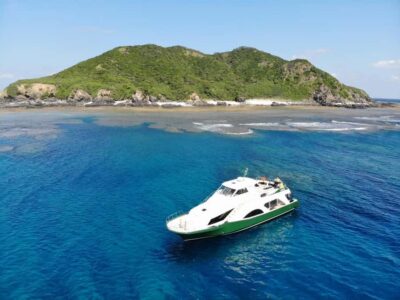
Naha:Kerama Island Experience Dive/Snorkeling/Whale Watching
Read our review →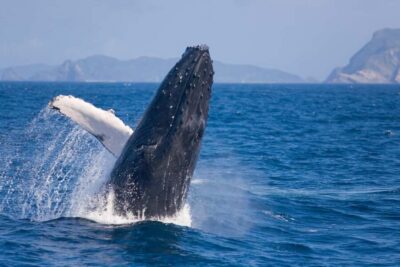
Naha: Whale Watching with Pickup and English Guide
Read our review →
Okinawa:Kerama Islands experience Diving/Snorkeling/WhaleWatching
Read our review →
Naha: “Orca” Spotting Glass Bottom Boat & Sam’s Famous Steak
Read our review →
Naha:Kerama Islands 2 Fun Dive/Whale watching Limited time
Read our review →
Naha : Kerama, Tokashiki Island and Whale Watching Tour
Read our review →
Browse the lists this tour appears in